

Cycling in Lanzarote: Why the Volcanic Island Is the Ultimate Cycling Paradise
Lanzarote is one of the best year-round destinations for cyclists in Europe. The island offers daytime highs ranging from 21 to 28 °C, very little rain, well-paved and quiet roads, climbs up to about 10 km in length, and a volcanic landscape unlike any other. The biggest challenge isn’t the mountain—it’s the wind.
Lanzarote is no longer an insider’s secret. Professionals, triathletes, and recreational cyclists come here primarily in the winter for training camps, while leisure cyclists and e-bike riders visit year-round. Whether you’re an ambitious road cyclist, mountain biker, or laid-back e-bike rider, the easternmost of the Canary Islands offers conditions that are unmatched in Europe.
On this page, you'll learn what makes cycling in Lanzarote so special, when the best time to visit is, which climbs and regions are worth exploring, and what rules apply on Spain's roads. We're Lanzarote Bike in Puerto Calero, and we ride these roads every day.
1. The climate: Eternal spring for your workouts
On Lanzarote, daily highs range throughout the year from 21 °C in January to 28 °C in August. Only about 110 to 150 mm of rain falls each year, almost exclusively between November and February, and even in winter there are only 3 to 4 rainy days per month. While snow and slush slow down training in Central Europe, here you can ride in just a jersey.
That's why the island is a popular destination for basic training and training camps, especially from October through April. You can find more details month by month on our page "The Weather in Lanzarote."


2. Spectacular landscapes that look like they're from another planet
The drive through Timanfaya National Park is one of the most impressive routes in Europe. Black lava fields, red volcanic cones, the white villages, and the deep-blue Atlantic Ocean in the background: the scenery is more reminiscent of the moon than of Earth.
Add to that the vineyards of La Geria, where each vine grows in its own hollow of volcanic ash, the cliffs of Famara, and the view from the Mirador del Río of the neighboring island of La Graciosa. Many of our routes combine these highlights into a single ride.
3. Excellent pavement and considerate drivers
The main roads on Lanzarote are well paved, and there is little traffic outside of towns. Many drivers are used to cyclists and keep their distance. Since October 2026, a stricter rule has also been in effect in Spain: Anyone passing a cyclist must maintain a distance of at least 1.5 meters (more on this below in the section on traffic rules).
Side streets and dirt roads can be rough or sandy in places. For this reason, a mountain bike is a better choice than a road bike.

4. The Challenge: The Wind as an “Invisible Mountain”
Anyone who cycles in Lanzarote will get to know the trade winds. They usually blow from the northeast and are strongest from late May through early September, often reaching speeds of 25 to 40 km/h in the summer. From fall through spring, they are significantly weaker; October is considered the calmest month.
The northern part of the island is more exposed to the wind, while the southern area around Puerto Calero and Playa Blanca is more sheltered by the mountains. Our tip: Start your ride into the wind and ride home with the wind at your back. Pros use the wind as a training stimulus—it makes up for the lack of Alpine passes. And if you prefer a more relaxed ride, hop on an e-bike.
5. A variety of profiles to suit every taste
Lanzarote offers the perfect terrain for every type of rider:
road bike: Long, flat stretches along the coast, combined with climbs such as Tabayesco (about 10 km) or the steep Femés. Our road bike routes range from 45 km to the grand island loop, which is 184 km long and has 2,560 meters of elevation gain.
Mountain biking: Gravel trails through lava fields, along the coast, and through the vineyards. There are only a few true singletrack trails; the island is more of a destination for endurance rides on gravel trails.
E-bike: Modern motors make hills and headwinds a thing of the past, so you can enjoy the view. With an e-road bike , even less-fit riders can keep up with the group.


6. Facilities for athletes in Puerto Calero
Puerto Calero is located on the south coast between Puerto del Carmen and Playa Blanca and is an ideal starting point: The climb to La Asomada begins almost right outside your door, the vineyards of La Geria and Timanfaya National Park are within easy reach, and the coastal road leads on flat terrain to Puerto del Carmen. After your ride, you’ll find cafés, restaurants, a supermarket, and the Sports Club at the marina.
Our shop is located in the garage of the Hotel Costa Calero. That's where you'll pick up your rental bike and can store it overnight in our bike storage room. Learn more about Puerto Calero.
When is the best time of year to go cycling in Lanzarote?
The best time to go cycling in Lanzarote is from October through May. During this period, daily highs range from a pleasant 21 to 25 °C, and the trade winds are weaker than in the summer. In the summer, it’s warmer and windier, but almost always dry.
| Time period | Daily highs | Number of rainy days per month | Wind | Ideal for |
|---|---|---|---|---|
| October–November | 23–25 °C | 2–3 | rather weak | Start of the season, long rides |
| December–February | 21 °C | 3–4 | gusty, mostly moderate | Winter Training Camp, Fundamentals |
| March–May | 22–24 °C | 0–2 | increasingly | Fitness Training, Race Preparation |
| June–September | 26–28 °C | 0–1 | strong (trade winds) | Early morning rides, e-bike, MTB |
Long-term averages, Arrecife Airport station (AEMET).
In the summer, it’s a good idea to start early in the morning: it’s cooler then, and the wind is even lighter. Even on days with Calima, when Saharan dust clouds the air, you should ease up on the intensity.
The Most Famous Climbs in Lanzarote
Lanzarote doesn't have any Alpine passes, but it does have several climbs ranging from 5 to 10 km that are well-suited for interval training and hill training. The distances listed are approximate and may vary slightly depending on the starting point.
| Increase | Length | Ø Slope | Distinctive Feature |
|---|---|---|---|
| Tabayesco , from Arrieta toward Los Valles |
about 10 km | about 5% | Longest steady climb, switchbacks in the upper section |
| Femés , near Playa Blanca |
5.6 km | 6 % | Last 800 m at 12%, with peaks up to 18% |
| La Asomada , by Macher |
5.3 km | about 5.5% | Close to Puerto Calero, with a view of La Geria |
| Los Valles , Teguise |
just under 8 km | about 4.5% | Part of the Ironman course |
River Viewpointoverlooking the Risco de Famara |
a good 7 km | about 3% | Exposed, view of La Graciosa |
These are approximate values; they may vary slightly depending on the starting point.
You'll find many of these climbs included in our road bike routes, complete with a Komoot link and GPX download.
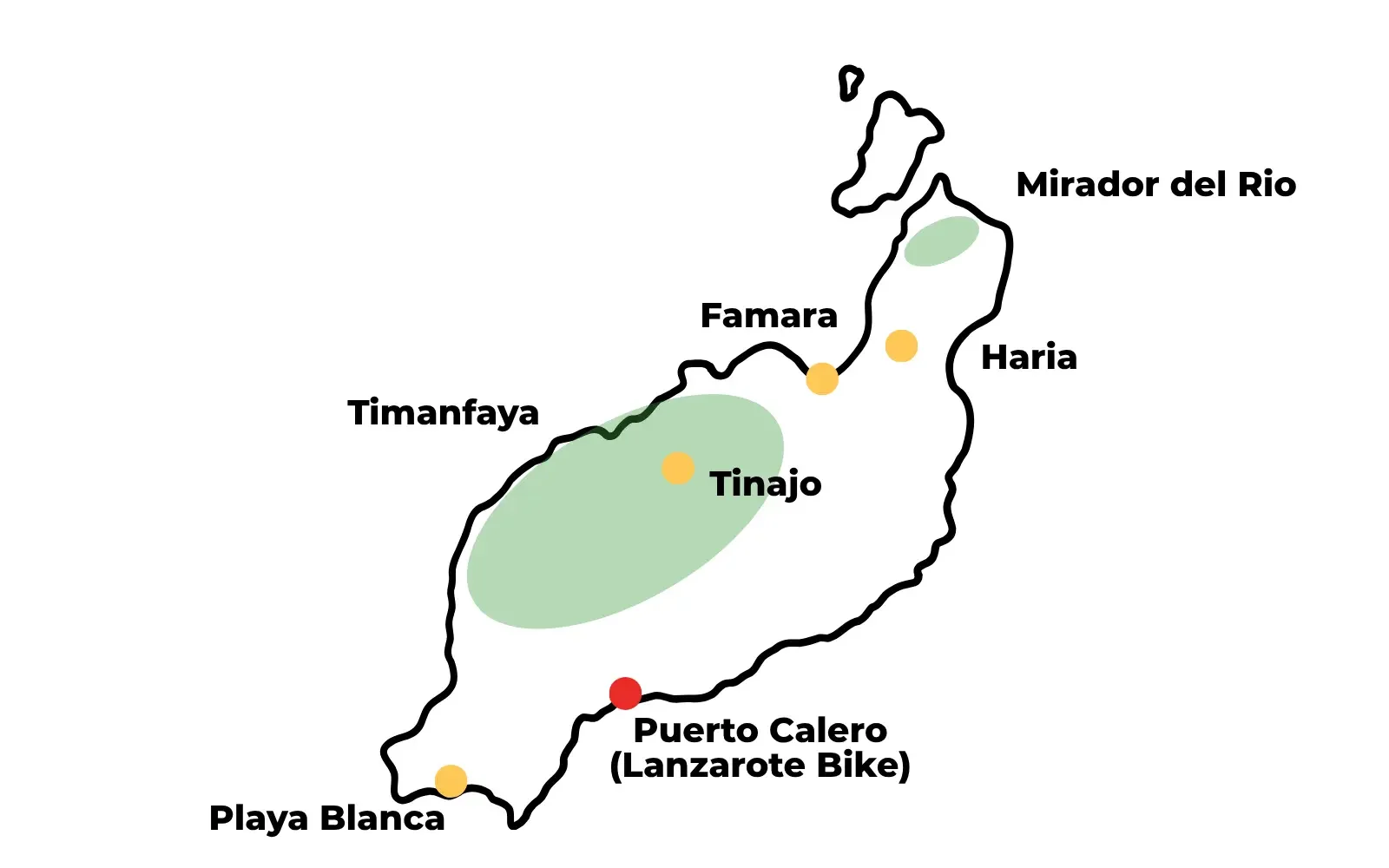
The Regions: Where Can You Go Biking in Lanzarote?
South (Puerto Calero, Femés, Playa Blanca): sheltered from the wind, featuring the steep cliffs of Femés and the salt flats of Janubio.
Central Region (La Geria, Timanfaya, Tinajo): Vineyards in volcanic ash, lava fields in the national park, winding roads.
North (Haría, Tabayesco, Mirador del Río): the longest climbs, green valleys, more wind.
West Coast (Famara): Cliffs and beach, ideal for mountain biking trails.
Is Lanzarote also suitable for beginners and leisure riders?
Yes. There are flat stretches along the south coast, for example from Puerto Calero through Puerto del Carmen to Arrecife. For any route with elevation gain or strong winds, an e-bike is the most relaxed option: it lets you reach the vineyards or the Mirador even without any prior training. If you’d rather explore the island with a guide, join one of our guided e-bike tours—in small groups and with a guide.
Traffic Rules for Cyclists in Spain
New rules to protect cyclists have been in effect in Spain since October 1, 2026. The key points are:
Helmet Requirement: Outside of town limits, all cyclists are required to wear a helmet, with no exceptions. We’ll lend you a helmet free of charge; please reserve one when you make your booking.
Overtaking distance: When passing, cars must maintain a distance of at least 1.5 m and drive at least 20 km/h slower than the speed limit.
In built-up areas: Cyclists may ride in the center of the lane whenever possible; vehicles behind them must maintain a distance of 5 meters.
Lights: You need front and rear lights when riding in tunnels or in the dark. A radar taillight like the Garmin Varia—which you can add to your order under “Extras”—provides added safety during the day.

Route Recommendations
Our recommendations for road bike, mountain bike, or e-bike routes on the island. There's something for every distance and difficulty level.

Our Location
Centrally located in the town of Puerto Calero, you'll find everything you need for a relaxing vacation or an intensive training camp: a supermarket, cafés, restaurants, and more.
Guided Tours
Don't want to ride alone? No problem! Several times a week, we offer guided e-bike and road bike tours of various lengths and difficulty levels.
Frequently Asked Questions About Cycling in Lanzarote
-
Yes. Lanzarote offers mild temperatures year-round, very little rain, well-paved roads with light traffic, and climbs up to about 10 km in length. The biggest challenge is the wind, especially in the summer.
-
The Passat wind usually blows from the northeast. It is strongest from late May through early September, often reaching speeds of 25 to 40 km/h. From October through April, it is significantly calmer. The southern area around Puerto Calero is more sheltered than the north.
-
Yes. Starting in October 2026, all cyclists in Spain must wear a helmet when riding outside of built-up areas. At Lanzarote Bike, you can rent a helmet for free while supplies last.
-
Renting saves you on shipping costs, airport hassles, and the risk of damage during transport. At Lanzarote Bike, you can rent carbon-road bikes s equipped with Shimano 105, Ultegra, or Di2 starting at €19 per day, with clipless pedals and delivery to your accommodation available upon request.
-
Yes, especially on gravel roads through lava fields, vineyards, and along the coast—for example, around Famara. The island is more suited for long rides on gravel roads than for technical trails.